

This article is part 2 of 2 on parish hospitality as a necessary moment of evangelization. See the first article, The Gospel of Welcome, here.
Every true renewal of the Church begins not with power, but with love—not with innovation, but with fidelity to the simple acts that make God’s mercy visible.
If the Church is to rediscover her missionary heart in our time, it will not be through a new program or campaign. It will come through a revolution of hospitality—a quiet, steady uprising of holy habits that reshape how we see one another, how we gather for worship, and how we extend Christ’s welcome into the world.
This revolution is not loud. It begins in the ordinary: a smile, a remembered name, a patient listening ear. But over time, these habits form hearts, and hearts form culture. The parish becomes what it was meant to be: a living sign of divine welcome.
The Spiritual Ground of Hospitality
The starting point of this revolution is theological, not tactical. Hospitality is not a “program” but a participation in the very life of God.
From the first page of Scripture, God is revealed as one who makes room for the other—creating the world not out of necessity but out of generosity. In the Incarnation, the Word takes on flesh and dwells among us, sharing our human condition. Jesus’ public life unfolds as an unbroken pattern of welcome: eating with sinners, blessing children, healing the outcast, and inviting the weary to rest in Him.
“Welcome one another, therefore,” writes St. Paul, “as Christ has welcomed you, for the glory of God” (Rom. 15:7). To welcome another person, then, is not a courtesy; it is a sacramental act, a participation in divine mercy.
When parishes understand hospitality in this light, they no longer treat it as a side ministry. It becomes the animating spirit of parish life—the sign that the Eucharist we celebrate is transforming us into the Body we receive.
The Habitual Nature of Holiness
Every revolution begins in the daily and the ordinary. So it is with holiness.
St. Thérèse of Lisieux, in her Little Way, reminds us that love is proved by deeds—“small deeds done with great love.” These small deeds, repeated daily, shape the heart. The moral tradition of the Church agrees: virtue is a habit formed through repeated good acts, elevated by grace.
Hospitality, too, is a virtue that must be practiced until it becomes second nature. A single act of kindness can touch a life; a thousand such acts, woven together, can renew a parish.
The revolution begins when disciples understand that the work of welcome is not extraordinary. It is simply daily fidelity to the command of love—the steady practice of turning toward, rather than away from, the other.
The Fruit of the Spirit: Kindness as Catalyst
Every true habit of hospitality is rooted in the Holy Spirit. As St. Paul writes, “The fruit of the Spirit is love, joy, peace, patience, kindness, generosity, faithfulness, gentleness, and self-control” (Gal. 5:22–23).
The Greek word for kindness, chrēstotēs, implies more than politeness. It carries the sense of active goodness—the graciousness of God translated into human form. When a parishioner greets a newcomer, offers a helping hand, or forgives a small hurt, the Spirit is at work.
Kindness is not weakness. It is divine strength in its gentlest form—the Spirit softening human hearts and creating space for grace to flow. The hospitality revolution is, at its core, a movement of the Spirit. Programs may assist, but only grace transforms.
The Five Pathways of Holy Habit
How, then, can we cultivate this revolution in parish life? The Mark 5:19 Project’s Personal Habits of Parish Hospitality offers a map—five interlocking habits that make the Gospel of welcome a lived reality.
Spiritual Habits: Prayer that Opens the Heart
Every external act of hospitality begins in interior conversion. Before Mass, take a moment to pray: “Lord, show me the person who needs Your love today.” This prayer changes posture—from observer to participant, from receiver to missionary. It prepares the soul to be a conduit of divine welcome. When we pray this way week after week, the habit of openness becomes a stable disposition. We begin to attend to others as God attends to us.
Awareness Habits: Seeing as Christ Sees
The first miracle of hospitality is attention. Our modern pace makes this difficult; we move quickly, heads down, hearts guarded. The Gospels show Jesus as a master of awareness. He sees Zacchaeus in the tree, the woman in the crowd, the hungry on the hillside. Each act of seeing becomes the beginning of healing. Parish hospitality begins when we practice this holy noticing—looking for the person who stands alone, the visitor unsure of where to go, the parishioner whose face betrays quiet sorrow. To notice is already to love.
Action Habits: Embodying the Welcome
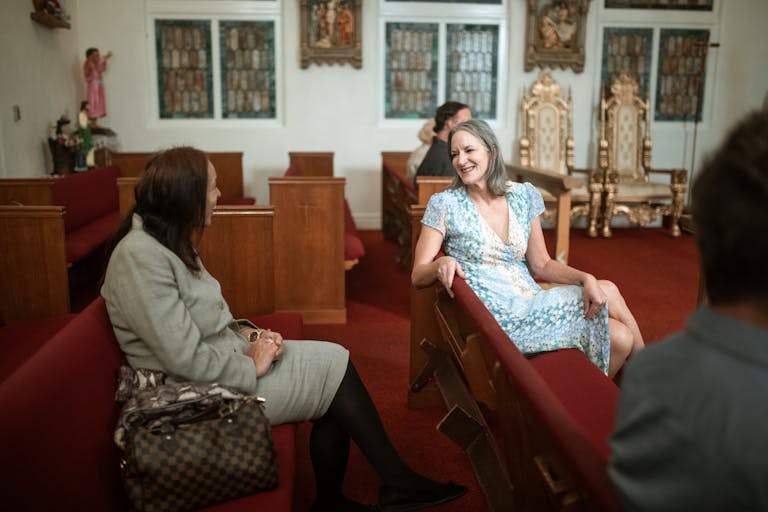
Kindness must take form. Smile. Offer a seat. Learn a name. Speak with warmth. These actions seem small, but they proclaim the Gospel without words. They say: You belong here. You are not invisible. You are loved. The hospitality revolution spreads through gestures like these—unremarkable in isolation, but transformative in accumulation. When many practice small love, great love appears.
Inclusivity Habits: Making Space for the Whole Body of Christ
The kindness of Christ always expands the circle. To practice inclusivity is not concession but fidelity to the Incarnation. Make room for those with disabilities. Offer clarity for newcomers. Be mindful of language that assumes everyone belongs to the same group or background. True hospitality is Eucharistic: it gathers the diverse into one table. As St. Paul reminds us, “The eye cannot say to the hand, ‘I have no need of you’” (1 Cor. 12:21). Each member of the Body belongs, and each deserves to be seen.
Sustaining Habits: Turning Encounters into Communion
Hospitality matures into relationship. Greet the person you met last week. Remember their name. Ask how they’re doing. Send a note of encouragement. These are not extra tasks but extensions of love. The Church grows when friendliness becomes fidelity—when the warmth of the first encounter endures in the weeks and months that follow.
When Habits Become Culture
At first, these habits feel intentional, even effortful. But repeated often enough, they become natural—and that is the turning point.
When kindness becomes instinctive, when welcome becomes ordinary, the parish culture shifts. What began as individual discipline becomes communal identity. The “feel” of the parish changes: visitors sense peace, regulars sense purpose, and the Spirit breathes through all.
Culture, after all, is the sum of habits shared. The hospitality revolution happens when grace forms not only persons, but communities—when a parish moves from doing hospitality to being hospitality.
The Eucharistic Shape of the Revolution
The revolution of holy habits is not new; it is the rediscovery of the Eucharist’s logic. At every Mass, Christ welcomes us to a table we did not set, forgives what we could not repair, and sends us to do likewise.
To build a parish culture of hospitality is to carry the Eucharist into daily life—to live outwardly what we receive inwardly. The greeter at the door, the teacher in the classroom, the usher guiding a visitor—each mirrors the hospitality of the altar.
In this way, every small act of kindness becomes an extension of divine communion. The revolution of hospitality is, in truth, a revolution of Eucharistic love.
Beginning Again, Small and Steady
No parish changes overnight. But every parish can begin today. Start with one act: learn a name, offer a prayer, open a door, invite a neighbor. Anchor kindness in prayer, and let repetition make it habit.
Grace will do the rest. The Spirit delights to work through the small. It was one cup of water that Christ praised, one mustard seed that became a tree, one widow’s mite that revealed abundance. So it will be with us.
Through holy habits, kindness becomes contagious. And through kindness, the Church becomes what she truly is—the living house of mercy.
Ready to start a hospitality revolution in your parish?
The Mark 5:19 Project offers The Gospel of Welcome: Becoming a Parish of Radical Hospitality, a practical workshop that helps parishes build these habits of holy kindness together. Reach out to learn more about this opportunity here.