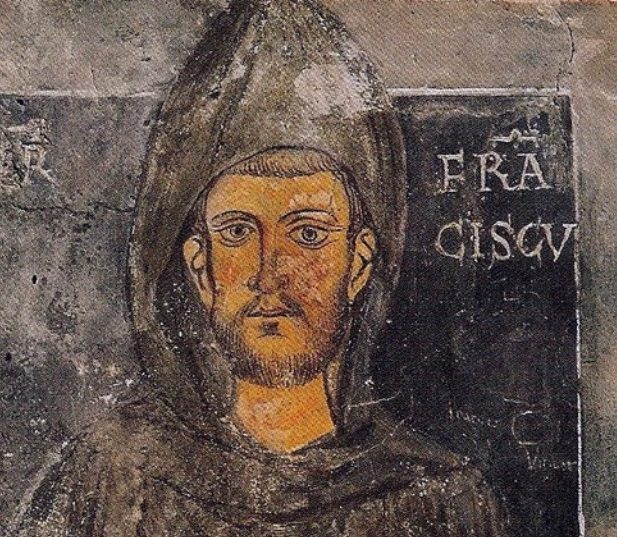


We continue to share stories of conversion to God and conversion to God’s people this month, and are honored to share a reflection (love letter, really) from Prof. Emily Dykman, a lay affiliate to the Franciscan Sisters of Perpetual Adoration, and our current board of directors chair. Francis of Assisi is a brilliant example of a saint with a profound conversion to God and conversion to God’s people, almost simultaneously. Emily’s reflection focuses on how 25 years of learning from different FSPA sisters has helped her see how to be a laywoman and disciple engaging God’s people wherever they may be, and honoring Christ in their midst. Thank you, Emily, for your work with The Mark 5:19 Project and with all those you teach and meet.
“For where two or three are gathered together in my name, there am I in the midst of them.” Matthew 18:20
Throughout my life I have been blessed by the model of leadership that my mentors have shared with me. I have been formed by many strong and intelligent women who have challenged me to see the world more broadly and critically in my day-to-day life. One community that has been particularly influential in my formation is the Franciscan Sisters of Perpetual Adoration (FSPA). I met my first FSPA sister as an undergraduate student at Viterbo University. I walked into my very first class, Music Theory I, and was introduced to Sr. Beth Saner. Later that day, I met Sr. Rita Rathburn, my English Composition teacher. These women crafted a pedagogy that was both engaging and challenging.
At the conclusion of my education at Viterbo University, the number of FSPA on campus as faculty had begun to decline, many retiring, some moving to other callings. I entered my first parish ministry position and was quickly immersed in parish life. I recall sitting at home one evening and realizing an incredible loneliness and longing for something more than my ministry was able to offer. I reached out to one of my mentors for advice and he encouraged me to call his wife, Marci, who had recently been hired by the FSPA to further develop a program for lay affiliation with the community. This was a relationship rooted in common values that emerged through community, ministry, and prayer.
When I began the sponsorship process, my partner, Sr. Carlene Unser and I began to explore Franciscan spirituality, leadership, and the questions of life. I would come back to La Crosse once a month to spend time with Sr. Carlene and explore what it meant to be Franciscan in the world. Sr. Carlene was an artist and faculty member in the art department at Viterbo University. In our conversations, Sr. Carlene shared her honest reflections on the gifts and difficulties of a life of voluntary poverty, the incredible value of prayer in her life, and her understanding of her commitment to minoritas.
This past June I celebrated 25 years as an affiliate of the FSPA. While my relationship with the community has ebbed and flowed over the years, I have found this community to be an inspiration for me as I ponder my relationship with God and with my neighbor. The gift of community, I have found, is diversity. The FSPA have taught me that there is no “one way” to live out the Franciscan charism. Each of us is called unique to a common charism rooted in community, prayer, and ministry. Over the years the Sisters have broadened my definition of “church” to include the community within the building as well as outside. Christ shows up within the ordinary of daily life, often in surprising and unexpected ways, but always in those spaces in which there is a gathering. I am a curious people-watcher and find myself wondering what is unspoken in those with whom I share space. I often wonder how God has shown up in the lives of others when they least expected.
My curiosity has been supported and increased by my relationship with the FSPA who recently recommitted themselves to their mission to hospitality, care of creation, solidarity, and reconciliation. My life has been enriched by their challenge to echo this charism in my own life and the model they have offered inspires me to live out similar actions in my own life. A few examples:
–Sr. Nina Shepard has modeled hospitality in her work as a musician and in her prison ministry. She is adamant that the dignity of each person is rooted in a divinity that cannot be deterred even by our worst deed. Sr. Nina has spent years creating a space of inclusivity through her dedication to the humanity of the others and her willingness to share her musical skill. As violinist, Sr. Nina has often invited me to join with her in creating a space of welcome and beauty. I was also honored to hear more of her vocational journey when she participated in an oral history project with Viterbo students.
–Sr. Lucy Slinger earned degrees in biology and plant pathology which led her to work in agricultural research and education. She recognized in mid-life that her love for the natural world was deeply connected to Franciscan spirituality and was led to the FSPA community which has offered her opportunities to use her expertise to deepen expressions of the Laudato Si initiatives with youth and young adults. Sr. Lucy created a sustainable, organic garden on the site of one of the Sisters’ rural properties which has become an opportunity for many to learn how they might be able to care for the created world in such a way as to remember their connection to all that God has brought into being.
–Sr. Laura Nettles, a middle-aged sister who was, for many years, my colleague at Viterbo University, actively demonstrated a need for solidarity that moved beyond words and into commitment to those on the margins. Sr. Laura spent several years teaching a course in World Religions that took our students out of the classroom and into the worship spaces of a variety of religions. This experience allowed young people to see the “other” has human and look to the potential of building relationship. She is also active in a local interfaith organization that has developed many opportunities for the La Crosse community to further see the “other” as neighbor.
–Reconciliation is possible when healing and wholeness begins to emerge. Over the past 20 years, I have watched Sr. Eileen McKenzie broaden and deepen the work of reconciliation. As a nurse, Sr. Eileen became interested in Eastern medicine and through study began certified in acupuncture. When she came to the community, a part of her ministry was offering this kind of alternative care within a space of spiritual care that could bring wholeness to the individual in her care. More recently, Sr. Eileen has been living on the border with Mexico and meeting recent migrants as part of the Kino Project. This work of reconciliation encompasses the hospitality and solidarity extended toward those who are coming the United States through great personal risk and drawing others into relationship and community.
Finally, a component of my FSPA affiliation commitment is participation within a local companion community. This community typically consists of affiliates with a somewhat common interest and a member of the FSPA who draws the community back into relationships with the sisters. Over my 25 years, I have participated in four communities, each with its own gifts and challenges. What I have come to realize through these companion communities is precisely what Jesus spoke in Matthew 18:20. In these gatherings, Jesus shows up. The conversation is energizing, inspiring, and motivating to continue to live deeper into the FSPA charism. These communities have become experiences of church in the sense of gathering at table, breaking open the Word, and breaking bread.
As a lay woman in the Roman Catholic Church, a wife, a mother, and a scholar, I have often found myself bumping into the ways in which I am called to gather with the church, the gifts I am called to share with the church, and the structure of the church in its ecclesial structure. At times, people have asked me why I would remain within a tradition that does not offer me a place of leadership within the hierarchy. For many years I struggled to find the right words to respond. I would often point to the Eucharist, Christ’s Real Presence. As I have clarified my understanding of Christ’s Real Presence, my answer remains the same, but is nuanced by the ways in which the FSPA have shown me ways of seeing Christ in the world. God calls me to be fully present in communities in which I live and world and to be open to Christ’s unexpected action in my life and the lives of those around. The FSPA and fellow companions have continually drawn me closer to Christ and closer to God’s people, through these gatherings of the Spirit and joy.
Please see the rest of our month of conversion to God, conversion to God’s people stories here: https://mark519project.org/category/missionary-discipleship-stories/