
Why Religion Went Obsolete, the “nones,” and the re-enchanted mission field
*Part 1 of a series, The Re-Enchanted Mission Field: Britain, America, and the Gospel After Secularism
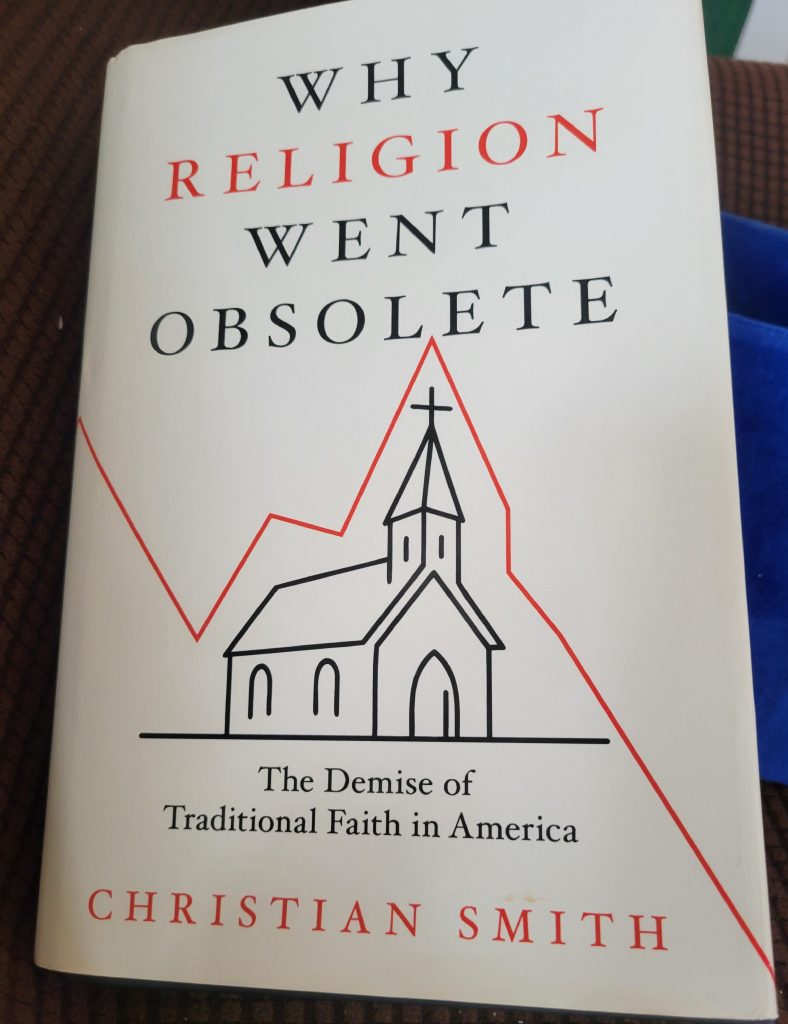
Christian Smith’s Why Religion Went Obsolete (Oxford, 2025) is arguably the most important sociological text of the decade. That is a large claim, but Smith’s long-term focus on the sociology of religion in the United States allows him to break open, in a new way, why we have seen “the rise of the nones.” For anyone who cares about evangelization, his argument matters because it challenges one of the assumptions many churches have been carrying for decades: that disaffiliation means secularization, and secularization means atheism.
We have often explained the rise of religious disaffiliation too simply. The story goes something like this: the Enlightenment gave us a society increasingly ordered by reason, science, technology, bureaucracy, and individual freedom. Traditional religion lost credibility. People misunderstood or rejected its basic principles. Eventually, religious faith was tossed into the trash heap of history. People increasingly had no use for it, and so they chose disaffiliation. Smith says this is not entirely correct.
He does not deny secularization. It is hard to imagine how we got here without the rise of secular culture. But he argues that if we only read the mission field as secular, we will misread the people standing in front of us. Many of the disaffiliated are not atheists. They are not even necessarily agnostics. They have put aside institutional religion, but many of them still pray. Many still reach out to a higher power. Many still seek meaning, transcendence, healing, mystery, and a sense that there is something larger than themselves. They are not simply secular. They are, in very individual ways, spiritual.
The old story: disenchantment
Max Weber, the nineteenth-century sociologist of religion, coined the phrase “the disenchantment of the world” to explain how the Western world increasingly describes reality through science, bureaucracy, calculation, efficiency, and rational systems rather than through mystery, myth, sacrament, spirits, or transcendent meaning. The disenchantment thesis became, in popular form, the “secularism overcomes religion” thesis.
There is truth here. We do live in a world where many people assume the material world is the only world. We do live in a culture where bureaucracies, technologies, markets, and therapeutic language often shape people more powerfully than religious institutions do. But Smith is telling us that this story is incomplete. If the endgame of secular philosophy and practice were simply atheism, we would expect many more atheists. Instead, we see many more people disaffiliating and saying traditional religion is not for them, while still remaining spiritually active, spiritually curious, or spiritually hungry.
As self-actualizing meaning seekers, we have a lot of “spiritual but not religious” out there. They have rejected the Church, or at least institutional religion. They have not necessarily rejected transcendence.
The Millennial Zeitgeist
Smith has a fantastic amount of publicly available and original data, resulting in a collection of cultural presumptions held within what he calls “the Millennial Zeitgeist.” In truth, this zeitgeist spreads across every generation that is post-Boomer. But it crystallized among Millennials as they came of age, not because of any one event, but because of the accumulation of many cultural shifts. Smith argues that the ever-building avalanche fell beginning decisively in 1991.
This matters because the Millennial Zeitgeist is not simply a set of ideas. It is an atmosphere. It is the air many younger adults breathe. It shapes what feels plausible, what feels oppressive, what feels authentic, what feels fake, what feels liberating, and what feels like death. In that atmosphere, institutional religion often feels suspect. But spirituality does not. Meaning does not. Mystery does not. The desire for healing does not. The longing for something larger than the self does not.
That is why Smith’s argument is so helpful. It allows us to name a form of disaffiliation that is not simply secular. It is not a clean rejection of God. It is a movement away from inherited religious institutions and toward personally chosen spiritual meaning.
Re-enchantment without the Church
What Smith has uncovered is closer to the “re-enchantment of America.” That is, people are finding, or placing, transcendent meaning into physical objects, experiences, rituals, and practices — as long as they are not part of a traditional faith. There is a high value on individual autonomy and choosing your individual faith. But Smith argues that it can look a lot like spiritual consumerism as well, because our cultural understanding of the human person is anchored in being a consumer.
Buying crystals on Etsy. Yoga retreats in another country. Visiting a Native reservation pow-wow. Finding a talisman object, a ritual, a practice, a symbol, a spiritual experience. The overwhelming majority of Americans are not formally embracing New Age philosophy, Hinduism, or Native spirituality. But they are often borrowing fragments. They are reaching for objects or events that carry a charge of meaning.
These people are not atheists. But they are usually disaffiliated. They are not secular in the strict sense. They are not Christian. They are not necessarily hostile. They are often spiritually alive, but religiously unformed. They are similar to, as Smith notes, a Christian understanding of pagans.
That word — pagan — needs care. It should not be used as an insult. It is not a sneer. It is not a way to dismiss people as foolish or primitive. In a Christian missionary imagination, “pagan” names a person outside the covenantal and ecclesial life of the Church, but not necessarily outside spiritual awareness. Pagan peoples are not people without religion. They are people with gods, rituals, longings, symbols, fears, sacrifices, practices, sacred places, and sacred objects.
That may be much closer to our actual American mission field than the word “secular.” The new pagans are uninterested — even deeply skeptical — of institutional religion, in part because institutions have been going insular, diving into protective mode, and decaying from the inside. In part, institutions have been under attack foundationally by modernist and postmodernist philosophy. But the new pagans are spiritual. They are not necessarily waiting for the Church, but they may be waiting for God.
Why this matters
Smith ends his book by stating that, as a sociologist, he cannot see how to address this as a religionist. Any approach seems to be a “damned if you do, damned if you don’t” scenario. But knowing the state of the mission field may yield insight to faith communities as to why this feels very uphill.
It is uphill because we are not simply dealing with secular atheists. And that means our response cannot simply be argument against atheism, or the emptiness of secularism. If the disaffiliated were pure secularists, the Church might focus almost entirely on apologetics, doctrinal defense, or arguments for God’s existence. But if many admit they are spiritually hungry, institutionally suspicious, and religiously unformed, then the Church needs something more basic and more beautiful.
We need first proclamation. We need hospitality. We need translation. We need spiritual accompaniment. We need to understand why Christian language does not land the way it used to. We need to make the first proclamation the first proclamation again: God is real, and he is love. He loved you in your messy sin and sent Jesus to retrieve, heal, teach, and save us for him through his death. He raised Jesus from the dead, and he is alive and near. He sent his Holy Spirit to empower you to live for him and share the good news in love and peace.
Or–we may need to recognize that if people are attracted to the unusual, the markers of spirituality that are not institutionally obvious, we offer those Christian customs as a way to the direct encounter with Jesus Christ. Rosaries? Miraculous medals? Monastic balance of work and prayer? To the uninformed–and most are uninformed–these are flashes of spirituality that can be examined just as some of the more atypical ones named above. But a friend needs to guide the person from the sacramental to the kergyma.
In the end, we read Smith’s analysis and know that the American Church may be tempted to keep mourning the loss of Christendom. But what if that is not the right frame? What if we are not simply post-Christian? What if the mission field is re-enchanted, spiritually hungry, institutionally wary, and waiting to hear the gospel not as cultural inheritance, but as news?
The next article will offer a contrast: what happens when a culture really does move closer to functional (and avowed) atheism. England may now be giving us a strange and important comparison, and cause for hope.