
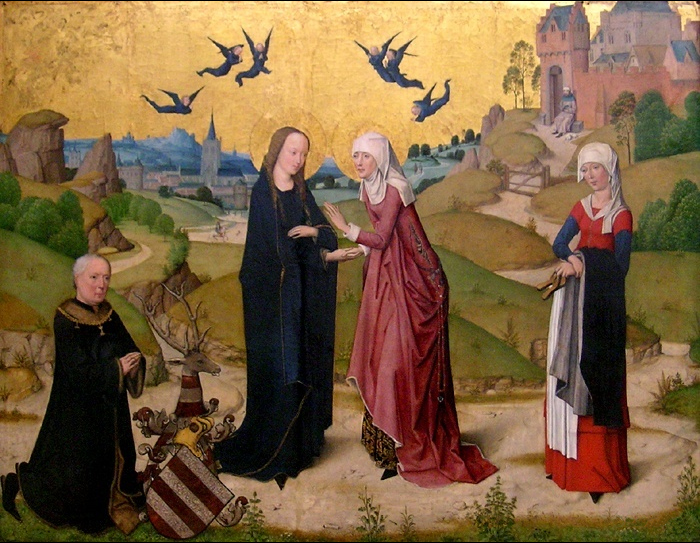
The Visitation, Meister des Marienlebens, 15th century.
We recently observed International Women’s Day and now find ourselves in Women’s History Month. (Women, apparently we get a whole month…)
That got me reflecting on what women, in particular, bring to evangelization and discipleship.
Years ago during the pandemic, I was able to pull together and host a virtual conference on women sharing the gospel in the United States called The Adventure of Sharing Christ. (You can still see the videos from Rachel Herbeck, Julianne Stanz, Kristin Bird, Donna Ottaviano-Britt, Deb McManimon, Denise Hirl, Allison Gingras, Christine Dalessio, Katie Taylor, and more.) The idea behind that gathering was that women have particular gifts for sharing the gospel that should be identified and honored, so women themselves can recognize, hear, and respond to their particular call to evangelize.
What got me thinking about this again, of all things, was Alysa Liu’s individual gold medal at the recent Olympics.
Let me explain.
Alysa Liu, Witness to Wholeness
I don’t want to hang more on Alysa Liu than is merited—I have zero knowledge of her religious beliefs—but that last free skate was an extraordinary sports performance. And as people recognized quickly, it was also an extraordinary life performance.
Liu competed in the 2022 Olympics and finished sixth, an astonishing accomplishment for a sixteen-year-old. She had already won a world championship even younger. But she was burned out and unhealthy, and after years of intense, isolating, critical training she was simply done. She retired from skating at sixteen and didn’t skate at all for more than two years.
Later she described what life looked like after abruptly ending her life on the ice. She spent time with family, something she had barely been able to do before. She made friends. She re-learned to eat after years of disordered eating. She discovered a fascination with art, psychology, and neuroscience, and enrolled at UCLA planning to work in psychology. Life was moving on, and in many ways it was very, very good. She was happy.
Then she went downhill skiing for the first time. On the first run she caught her breath at the sensation—the glide. That incredible glide over snow and ice. It awakened the memory of her first love, the feel of skating.
She began to wonder whether she could return to skating without letting it define her entire identity. About a year and a half ago she decided to try—not to win a medal, but simply to skate again. She wanted to enjoy the glide, the challenge, the process.
She said repeatedly in interviews that she was not skating for medals. She wanted to challenge herself, create art, and show people what she could do. Few people believed her at first–of course you skate in world championships to win. But when she stepped onto the ice at the 2026 Olympics, something about her performance made it clear that she meant exactly what she had said. She skated because she loved it.
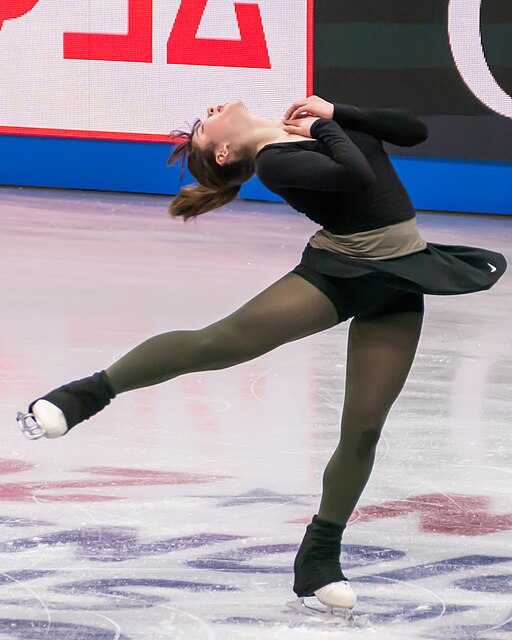
She skated with a remarkable wholeness—freedom, joy, and presence. Commentators and audiences recognized the moment immediately as something unique, special and fundamentally different from competition skating. And, if it matters, she won.
The Gift of Women in Evangelization
That witness in that skate has stayed with me, because women often bring a similar wholeness of heart to discipleship and evangelization. That wholeness grows out of knowing who we are and whose we are.
St. John Paul II often observed that women contribute to the world and to society not only by what they do but more fundamentally by who they are. Of course this insight speaks to the dignity of every human person. But John Paul II also suggested that women often bring something distinctive: a particular attentiveness to persons and relationships, and a capacity to give themselves to God with a wholeheartedness that becomes visible to others.
In reflecting on the 150th anniversary of the apparitions of Mary at Lourdes, John Paul II wrote that the woman who gives herself fully to God—whether through consecrated life or through a wholehearted yes to God in her circumstances—stands as a kind of “sentinel to the Invisible.” In other places he describes such a life as prophetic (Mulieris Dignitatem, §§16, 29).
I love that language and the insight behind it. When someone lives with that kind of wholeness before God, their witness draws others to marvel and to wonder what it would be like to live that way themselves.
Wholeness creates freedom, because the person is no longer defined by the expectations and anxieties around them.
Wholeness creates joy, because the person is no longer performing for approval but living out of a deeper center.
And wholeness becomes prophetic witness, because it quietly reveals another way to live.
This, I think, is one of the gifts women bring to the Church and to evangelization. Their witness reminds us that evangelization is not primarily about strategies, programs, or messaging. Those things play a role, but the gospel spreads most powerfully through lives that radiate freedom, joy, and integrity.
Women, in their particular way of seeing persons relationally and offering themselves wholeheartedly to God, help evangelization resist the temptation to become something like a marketing enterprise. Their witness points us back to the deeper truth that the gospel is not a product to promote but a life to be lived.
Not just in March, but every month of the year: listen to the women. At the visitation, at the cross, at the tomb, in your community–they have a truth to share in their lives and words.
The photograph of Alysa Liu is from a world championship practice in 2025. FloweringDagwood, CC BY 4.0 https://creativecommons.org/licenses/by/4.0, via Wikimedia Commons