


Many parish renewal efforts fail—not because of strategy, but because of culture. Here’s why parish culture is the true soil of mission growth. This article was part of a presentation at Viterbo University, to the PATHWAYS Thriving Congregations cohort. Part 1 of 2. You can find Part 2 here.
Why Do So Many Well-Designed Parish Plans Stall?
We underestimate the power of the parish culture. Yes, people repeat “culture eats strategy for breakfast” all the time. But that’s an observation, not a solution. And not terribly constructive or hopeful.
I prefer starting with Jesus’ own words, and well known ones at that: the parable of the sower (Luke 8:4-8). Jesus is the farmer that sows the seed, and sows it liberally. Some soil refuses it. Some soil chokes it out. Some seeds can’t burrow and get picked off by birds. But some soil is rich, soft, nourishes the seed, and yields a bountiful harvest. The soil is our parish culture.
This really isn’t a strange metaphor, that soil = culture. Culture literally comes from the Latin word, colere, which means to till, tend, and enable growth of a people or a land. (There is also a connection to worship, but that’s for another day!) Cultures literally exist to grow things.
So what is your parish culture growing? Seeds thrive or perish beginning when they hit the ground–so you have to look at the dirt itself.
Defining a Parish Culture
People often don’t like talking about culture, because it feels ambiguous and idealistic. Let’s define culture as simply as we can: the environment of shared values, made visible through repeated habits. Culture shows us what our true hopes and desires are, by unspoken but strong expectations of what is expected and what is “not allowed.” Any time you brought up that we should be inviting people to come back to Easter mass–and you got uncomfortable silence? That showed you better than a mission statement what your parish culture’s operating values are.
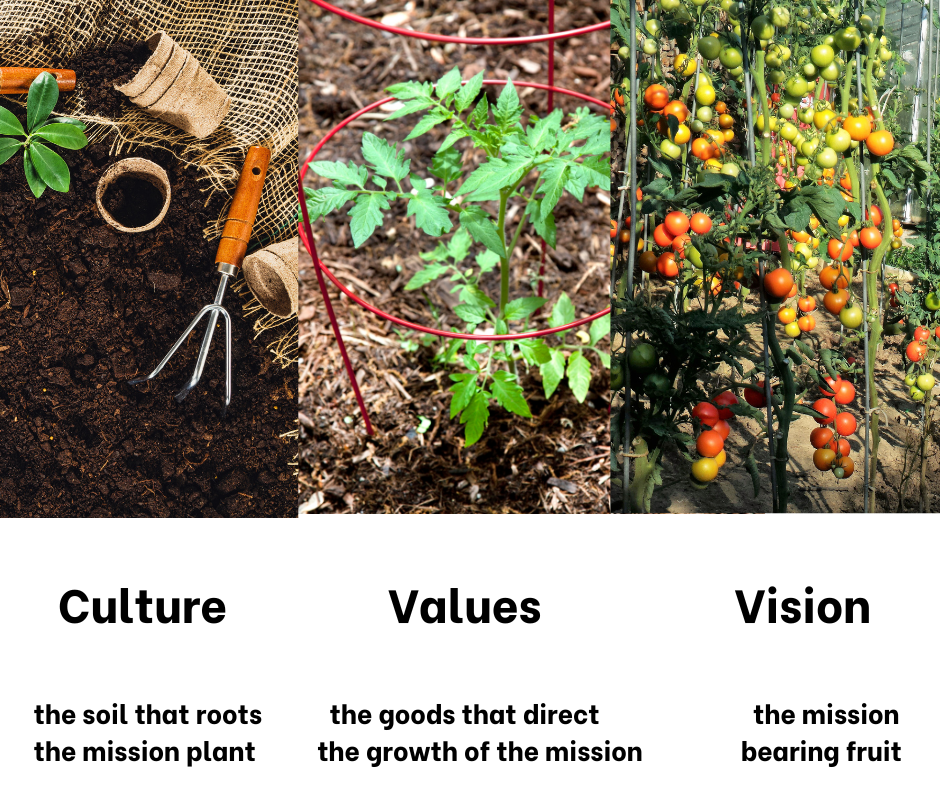
Parish environments are made of three elements: an internalized vision of its future (the future reality of a thriving mission), the timeless values that point toward that future (agreed goods that produce the future vision), and the culture of present practices (the habitual actions of the everyday). Ideally, these elements work together in relationship to strengthen the identity and goals of the community. Think of a “mission plant”:
When Parish Culture Fails, There is a Functional Breakdown
Many Christian congregations and communities struggle with a parish culture that is resistant to evangelizing. Evangelization is in the DNA of Christian identity. So what’s the problem? Why do many parish cultures struggle with this?
It’s a mismatch of these elements–a functional breakdown, or call it a misalignment. But the simplest way to understand this? The community is confused.
There are three ways the elements find themselves in functional breakdown.
- Right values without matching culture → hypocrisy
- Right vision without matching values → trend-chasing
- Right culture without any vision → stagnation
Any one of us can sit with those functional breakdowns and reflect on our own communities…and there are a lot of ways a parish culture can fail. I admit a lot of my work has focused on the third option: a lack of vision. Parish leaders should be inviting God to show them his vision for the parish. Given our religion is full of visionary language, this should seem obvious. But perhaps the American pragmatism and everydayness of life allow us to forget the fullness of God’s mission, fulfilled. And we need to hold that in mind, literally visualize it, to know in which direction to grow.
However, I am increasingly convinced we also have a real functional breakdown with the first option: the right goods are in place but the parish culture isn’t buying it. For example, one real good is invitation. If the Christian God is the greatest good we can encounter and he loves us unconditionally, doesn’t that sound like a Deity you want to come and see? Should inviting people who do not know the Lord is good to come a first priority? Yet people simply rarely do it. That’s a cultural issue. They may nod politely, but they are not buying that good.
The first hard question is to ask is why there is a parish culture and evangelical values disconnect.
The Hard Question
Why doesn’t the lived experience of our parish culture reflect our stated values?
I would say there are two reasons. First, keep in mind that the parish culture is actually a subculture within a prevailing culture. If we call that prevailing culture American culture, we have to recognize continually that people who spend 90% of their time living in the vision, values, and culture of that world are going to drag that vision, those values, that culture into the Catholic subculture of your parish. We know this. But maybe in our relative comfort, we don’t realize what an impact current American culture has on Catholic values. Catholics (and all Christians) are truly swimming upstream every day. That means, at minimum, the parish subculture needs to be crystal clear in its vision, values, and resulting identity. And sometimes, it really isn’t in the minds of everyday Catholics.
It’s hard to live in two value systems. Yet here we are.
Secondly, and related: Catholic parishes are not just a subculture—we are a counter-culture. And this is not new. “My Kingdom is not of this world,” and “The Kingdom of God is among you”: Jesus Christ said both of those things. To uphold values that are not the prevailing culture’s is normal. And yet, I’m afraid we think we can have it both ways.
It’s not that good things cannot exist within American culture. As in all human cultures, there are elements that are worthy. But there are values and visions that simply feed into the worst temptations rooted in original sin: pride, vanity, and more. Jesus called us to more, and to difference.
Finally, one piece I want to introduce, and unpack in Part 2. So we’re a subculture that has functional breakdown, and a counter-culture at the core. This could be the case if the prevailing culture and the parish subculture were simply different. But the past year makes me wonder: what if the prevailing culture isn’t just different, but malicious to parish culture?
Is There a Pesticide among Us?
Let’s return to our metaphor: culture = the soil. If cultures are meant to grow things, different visions and values can confuse the mission plant. But what if there are rising visions and values in the prevailing culture that actually try to kill it?
That, friends, is typically what we call a pesticide. And while I am not against a careful use of pesticides in actual agriculture, the reality is that pesticides weaken the soil. And when the soil (culture) is weakened, the mission plant has little in which to grow. Often, plants will just wither and die.
What if we have great plans, an inspired tradition, and a vision of fruitfulness–and our soil, the parish culture, is under quiet attack?
If the soil itself has been damaged, no program will fix it. We have to restore the soil.
The counter-culture to malicious visions and values has it’s own powerful vision and values. And we will unveil them all, and how they work, in Part 2.