
I recently read a Leadership Roundtable survey on the spiritual lives of young adults, and one line has stayed with me: more than anything else, young people are looking for community. They want friends. Honestly, don’t we all? Very few people are wired to go through life as a lone ranger. At our core, we are pilgrims on the way to the Father—together.
Many parishes like to highlight their warmth and friendliness. And some parishes really do embody that, beautifully. But there’s a big elephant in the room:
How do your parishioners actually know each other?
This may sound like a silly question, but it isn’t. If parishioners primarily know each other through shared workplaces, a school PTA, or any other external environment where friendships naturally form, that doesn’t automatically mean your parish is glowing with Christ-centered friendship. It means people with pre-existing relationships are reconnecting at church.
If your reaction is, Yikes, that feels a little harsh!—hear me out. Those external friendships may be wonderful, fun, and genuinely life-giving. There is nothing wrong with them! But they don’t necessarily reflect a parish culture that extends Christ-shaped friendship to everyone. What you really have is friend groups who come to worship together.
I’ll admit: I’m probably more sensitive to this than most. I’m an introvert (despite being able to turn it on for speaking and teaching!), and I’ve moved a lot. I’ve had to plug into new parishes, find new friends, start from scratch—or in a few cases, stay put while changing workplaces and realize those work friendships weren’t going to carry forward. Making friends as an adult is hard! But it shouldn’t be hard for newcomers—or longtimers—at your parish. A parish should foster Christ-centered friendships as part of its very identity.
A few questions to sit with:
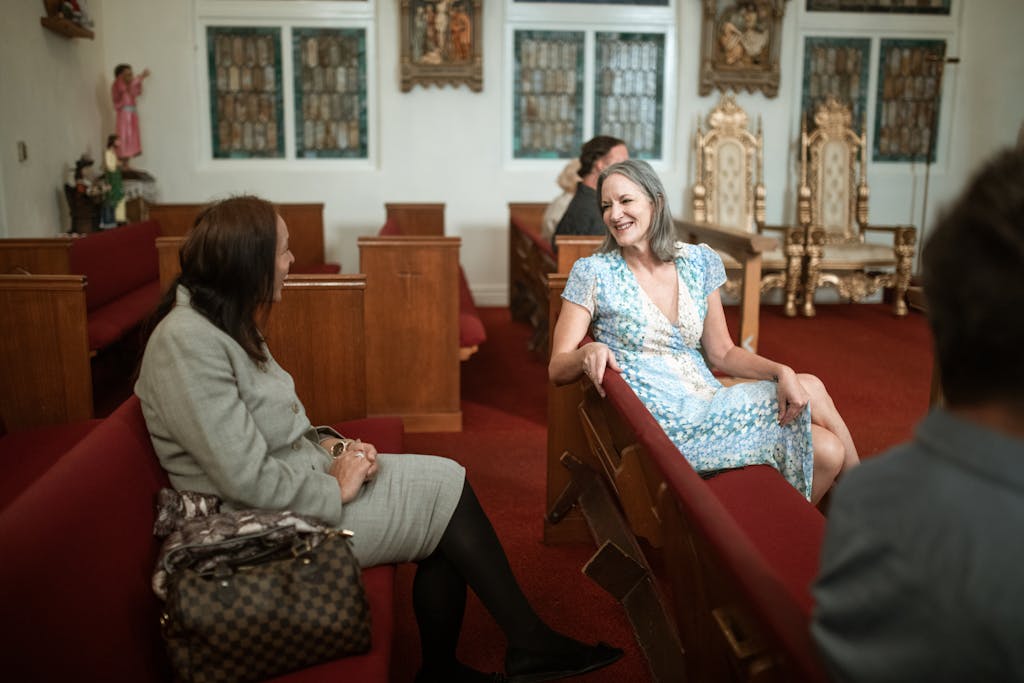
- Who do you talk to as you enter or leave Mass? Co-workers? Parents from school? Or people you’ve come to know through parish life? Or…no one?
- Is your after-Mass fellowship (a.k.a. coffee and donuts) a space for friend groups to reconnect…or a space to meet new people?
- Friend groups will always exist. But do they regularly invite others into conversation?
- Are there small groups—Bible studies, prayer groups, service teams—that intentionally build Christ-centered friendships?
Here’s the reality: no one sets out to create cliques. But circumstance-based friendships gathered at church can feel like cliques to anyone on the outside. If someone is new, shy, or simply not part of the main social circles in the town, parish life can be painfully lonely. And when young people tell us that their #1 question in choosing a church is Is there community?—we should listen.
So the challenge before all of us is this:
How do we make our parishes places where Christ-centered, life-changing friendships are formed, fostered, and celebrated?
So how do we make our parishes places where Christ-centered, life-changing friendships are formed, fostered, and celebrated? I think we have to acknowledge a basic truth about being human: small is beautiful. We grow best in settings where we can be known, welcomed, and held accountable in love. And that means most parishes have two essential pathways—small groups, a renewed focus on the family, or ideally, both.
1. Small Faith-Sharing Groups
If friendship and discipleship are going to flourish, people need places where they can be real. Large gatherings—Mass, parish events, even coffee hour—can be energizing, but they rarely cultivate the kind of intentional relationships that help someone follow Jesus more deeply. Small groups do.
Small faith-sharing groups give parishioners a circle of people who know their names, notice their absences, and pray for their needs. They create space for Scripture to meet real life, for vulnerability to be met with compassion, and for friendship to form slowly and organically. These groups don’t have to be fancy—six to ten people, one hour a week, Bible in hand, and a heart open to the Holy Spirit. But they need to be consistent, invitational, and widespread. A parish that wants to grow Christ-centered friendship needs more circles than rows.
2. Focus on the Family
The second pathway is the family—your first small group. A parish that wants to cultivate friendship has to invest in strengthening the “domestic church.” Families who pray together, eat together, and spend time together form people who understand community as a way of life, not an extracurricular activity. This means supporting marriages, encouraging shared family practices of prayer, offering parenting formation, and helping households rediscover Sabbath rest.
When families are strong, children and adults alike come to church already shaped by the rhythms of relationship. They arrive primed for fellowship—not intimidated by it.
3. Diminish the Screens
And finally, a hard truth: screens are killing community. Or at least eroding its possibility. If we want genuine, eye-to-eye, soul-to-soul friendship, we need to dramatically reduce the presence of screens on parish campuses—including schools. Technology has its place, but it cannot mediate Christ-centered friendship. If anything, it forms us to avoid the very vulnerability friendship requires.
What if parish lobbies were phone-free zones? What if youth ministry meetings required phones in a basket? What is faith formation were more than watching a show? What if schools had tech sabbath days? Small steps, big cultural shift.
At the end of the day, building a parish rooted in Christ-centered friendship doesn’t require complicated programs or flashy initiatives. It requires choosing what is small, human, and real. When we create spaces for intimate faith-sharing, strengthen families as the first communities of love, and clear away the digital noise that fragments our attention, we make room for actual encounter. This is how a parish becomes more than a place people attend—it becomes a home where people are known, welcomed, and accompanied on the way to the Father. Community happens one relationship at a time. And when those relationships are webbed together, they become an icon of the universal Body of Christ.